CITY GUIDE · CYPRUS

Paphos Expatriation Guide

The fourth-largest city in Cyprus and a jewel of the island's south-west coast, Paphos draws expats with its sunny climate, moderate cost of living and UNESCO-listed seafront setting. This guide…

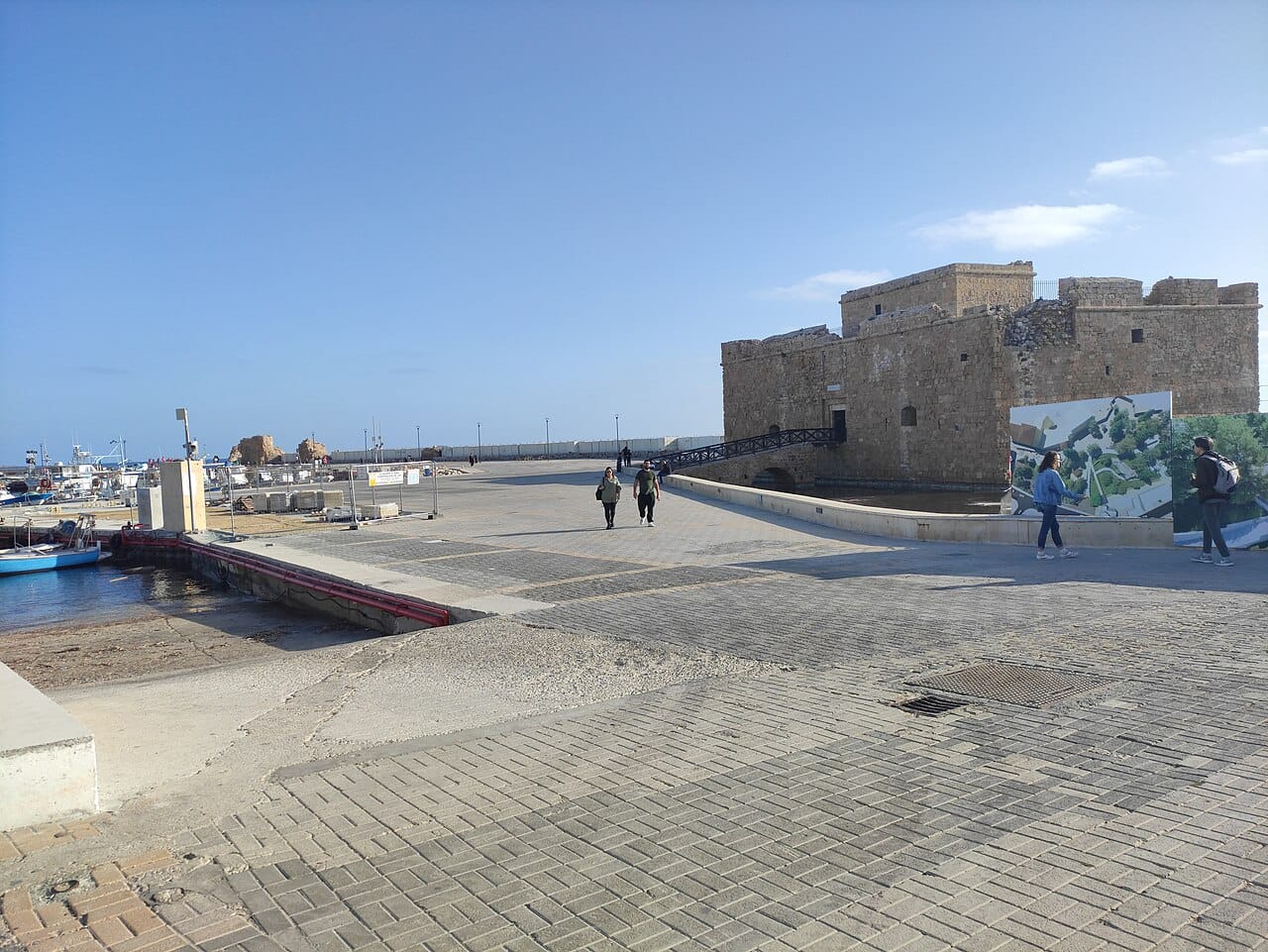
Fry72, Karel Frydrýšek · CC BY-SA 4.0

Prepare your move to Paphos

Join the waitlist and we'll email you the moment RelocDesk opens for Paphos.

TABLE OF CONTENTS

Overview

Set on the south-west coast of Cyprus, Paphos (around 35,000 residents in the city, more across the wider district) blends ancient heritage with a relaxed Mediterranean lifestyle. Its archaeological park and necropolis are inscribed on the UNESCO World Heritage List.

The city enjoys one of Europe's mildest Mediterranean climates, with close to 340 days of sunshine a year and gentle winters. It is served by Paphos International Airport (PFO), connected to many European cities, and lies about 150 km from Nicosia, the capital.

Long popular with British retirees, Paphos now attracts a broader mix of families and remote workers, drawn by its calm pace and prices noticeably lower than in Limassol.

Healthcare in Paphos

Cyprus has a national health system, GESY (General Healthcare System), fully operational since 2019. It is open to registered residents, including contributing expats, and covers general practitioners, specialists, hospital care and medicines.

Contributions are a share of income (about 2.65% for employees, 4% for the self-employed). With a GP referral, a specialist visit costs around 6 EUR; without a referral, roughly 25 EUR.

In Paphos, care options include:

  • Paphos General Hospital (public), for emergencies, surgery and diagnostics.
  • Well-regarded private clinics such as Iasis Hospital and St George's Hospital, with quality comparable to Western Europe at lower prices.
  • Numerous pharmacies and dental practices (dental care is mostly private).

Many expats take a hybrid approach: GESY for everyday care and private insurance for hospital treatment and added comfort. A private consultation often costs 50 to 80 EUR, and monthly healthcare spending commonly falls between 150 and 300 EUR per person.

Taxation

Attractive non-dom status

There is no city-level tax: Paphos follows the national Cypriot tax framework, widely regarded as favourable for expats. The information below is indicative and is not a substitute for professional tax advice.

The non-dom (non-domiciled) regime exempts Cypriot tax residents, for 17 years, from the Special Defence Contribution on dividends and interest earned worldwide. Such income is only subject to the GESY health levy of 2.65%, calculated on a capped income base (180,000 EUR per year).

Other key points:

  • Corporate income tax rose from 12.5% to 15% on 1 January 2026.
  • The first band of personal income is tax-free (the threshold was raised under the 2026 tax reform), after which progressive rates apply.
  • There has been no national immovable property tax since it was abolished in 2017.
  • Local municipal charges still apply (refuse collection, sewerage, street lighting), in the region of 85 to 300 EUR per year depending on the property; in Paphos the refuse fee is often billed with the water charge.
  • On purchase, transfer fees (3 to 8% of value) apply unless VAT has already been paid (new-build homes). Stamp duty was abolished on 1 January 2026.

Schools in Paphos

Cypriot state schools are free but teach in Greek, which suits families settling for the long term. For an English-language education, Paphos has several private international schools, mostly following the British curriculum (IGCSE and A-Levels).

  • The International School of Paphos (ISOP): British curriculum from nursery to A-Level, indicative fees of around 5,500 to 9,000 EUR per year depending on the year group.
  • TLC Private School: British curriculum (Key Stage 1 to 5), around 5,000 to 8,500 EUR per year.
  • Aspire Private British School: Pearson Edexcel programme, around 4,500 to 7,500 EUR per year.
  • Lumio Private School: British curriculum for younger pupils, around 4,000 to 6,500 EUR per year.

Teaching is mainly in English, with Greek offered as an option. Nurseries and kindergartens take children from age 2 to 3. The school year runs from September to June; as places are limited, it is wise to apply well in advance.

Cost of Living

Paphos is the most affordable city in Cyprus: budgets are generally 20 to 30% lower than in Limassol, with the gap driven mainly by rent.

Excluding rent, a couple spends on the order of 1,500 to 2,000 EUR per month. A few benchmarks:

  • Groceries: about 350 to 500 EUR per month for two.
  • Electricity and water: 150 to 250 EUR per month, peaking in summer (air conditioning).
  • Fibre internet: 30 to 40 EUR; a mobile plan around 15 to 20 EUR.
  • Dining out: a meal at a taverna costs 15 to 25 EUR per person.

Fuel and transport are cheaper than in Western Europe, but a car is all but essential, as the bus network is limited. Overall, Paphos offers a Mediterranean lifestyle on a contained budget.

Housing

Paphos's rental market remains more affordable than Limassol's, though prices have risen noticeably in recent years. A one-bedroom apartment rents for around 600 to 900 EUR per month in ordinary neighbourhoods, and more like 900 to 1,500 EUR in sought-after seaside areas; a villa often exceeds 1,200 EUR.

To buy, expect around 2,200 EUR/m2 inland and 4,500 EUR/m2 and above on the seafront (Kato Paphos, Coral Bay), depending on the area.

Neighbourhoods to know:

  • Kato Paphos: the heart of expat life, seafront and shops.
  • Coral Bay and Peyia: beaches and upmarket properties.
  • Universal, Chloraka, Tala: residential areas popular with families.

Practical tip: favour a written lease of at least one year, ideally registered. This proof of address eases administrative steps, notably obtaining the registration certificate (the well-known yellow slip) for EU nationals.

Prepare your move to Paphos

Join the waitlist and we'll email you the moment RelocDesk opens for Paphos.